
You want results that feel solid in your hands. I’ve tested these on cold benches and warm rooms. Plastic shells feel light yet stable. Wires click in with a soft snap. Pick a sensor that matches your job and you save hours.
Start simple. DHT11 suits indoor air checks. It’s cheap and easy. You get quick reads that feel like a steady drumbeat.
Step up to *DHT22 or AHT30* for tighter accuracy. They track wider ranges and react faster. Need water or harsh air? DS18B20 waterproof probes handle it like a fish in water.
Think about how you wire and power it. I’ve seen messy builds fail from poor choices.
- Accuracy: tighter tolerance gives truer temps
- Range: cold outdoors or hot liquids need wider limits
- Interface: I2C feels simple, one wire saves pins
- Power draw: low draw helps battery builds
- Response time: fast sensors catch quick swings
Match the sensor to your use and it clicks. Keep going and you’ll land on the right fit.
HiLetgo 5pcs DHT11 Temp Humidity Sensor Module
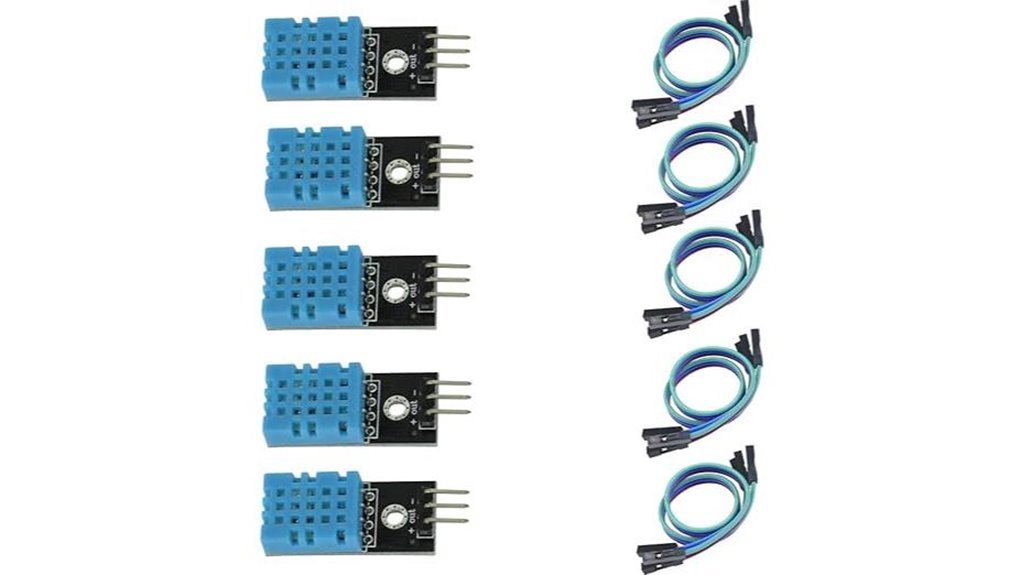
If you’re new to Arduino, this little board feels like a gentle handshake. I’ve used the HiLetgo DHT11 on quick builds, and it just works without drama. You wire one data pin, power it up, and you’re off. *That’s as easy as flipping a light switch.*
You get *digital temperature and humidity readings* right out of the box. The signal feels clean and steady when you watch it on serial output. I’ve noticed it reacts fast enough for room changes, like walking from a cool room into warm air.
Inside sits a basic sensor setup with a tiny chip doing the thinking. You don’t see it, but you feel it in the stable readings. It handles everyday conditions like a calm driver in traffic.
Best For:
You want a simple Arduino humidity sensor for learning or small home projects.
Key Specs:
- Voltage: 3.3V to 5V support
- Humidity range: 20% to 95% RH
- Temperature range: 0 to 50°C
- Output: Digital single wire signal
Pros:
- *Quick setup* saves you time
- Works with most Arduino and ESP boards
- Pre calibrated so readings feel consistent
Cons:
- Narrow range limits outdoor use
- Accuracy feels basic for precision work
- Update speed suits slow changes
In my experience, this sensor fits like a starter tool in your kit. It gives you clear data without extra fuss, and that’s exactly what you need early on.
2pcs AHT30 Temperature and Humidity Sensor Module
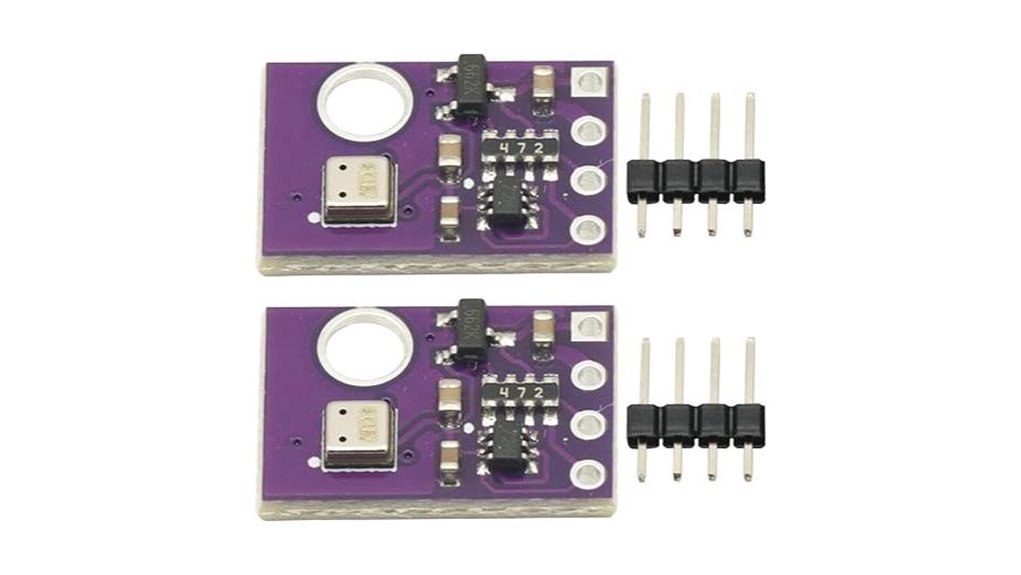
For Arduino builds I grab this AHT30 module when I want clean data fast. I plug it in and it feels light and crisp in hand. The board stays cool and quiet like a calm room. You get *tight readings* with ±0.3℃ temp accuracy and ±2% RH. Setup feels like a walk in the park. You wire four pins and start logging over I2C. Power range spans 2.0V to 5.5V so it fits many boards. It reads -40 to 85℃ and 0 to 100% RH with fine resolution. Data comes in smooth and steady like a metronome. I’ve chained a few on one bus and it stays stable.
Best For:
You want quick Arduino projects with precise temp and humidity data. You value low power and simple wiring. You like sensors that just click.
Pros:
- *High accuracy* with ±0.3℃ and ±2% RH
- I2C bus supports several sensors on one line
- Wide 2.0V to 5.5V input and low power draw
Cons:
- You need basic I2C skills to read data
- Wired setup keeps it on the bench
- Small board feels delicate in hand
Gikfun DS18B20 Waterproof Temperature Sensor 3-Pack
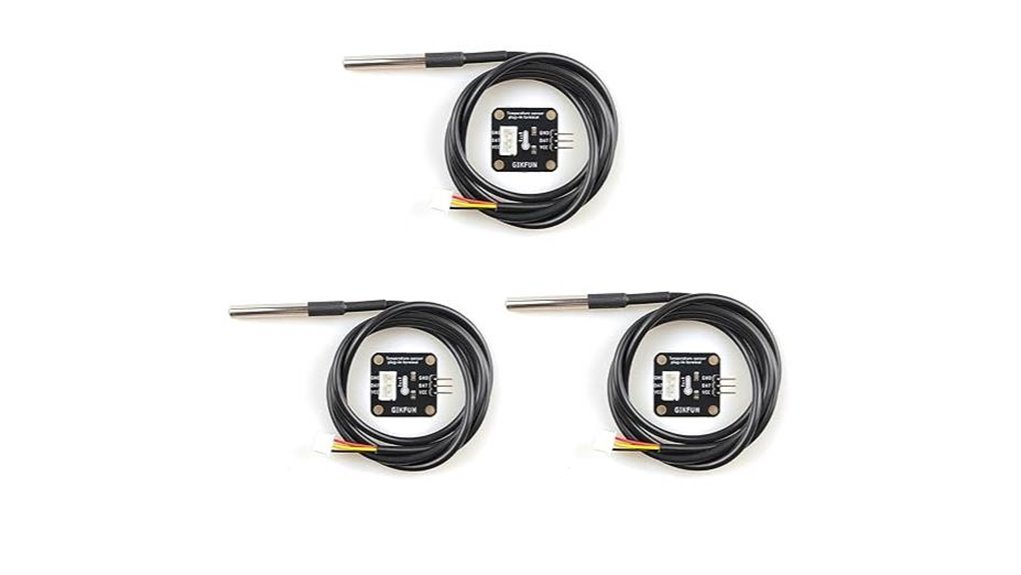
The Gikfun DS18B20 *Waterproof Temperature Sensor* 3 Pack feels like a trusty tool I reach for in messy builds. I’ve dipped these probes into tanks and damp soil and they keep ticking like a clock. You get three sealed stainless probes that feel cool and smooth to the touch. Each one connects fast with its adapter so you skip breadboard headaches.
Setup feels like plug and play bliss. I clipped one into an Arduino and saw clean data within minutes. The onboard pull up resistor keeps wiring simple and tidy. The DS18B20 digital interface speaks a common language across boards.
You can track water temp in a fish tank or check heat in a greenhouse with steady results. The range spans from -55 to 125 ℃ so it covers most DIY jobs. Power runs at 3.3V or 5V so you get flexible builds. The color wires help you avoid guesswork during setup.
It’s like having a thermometer that thrives in the rain.
Best For:
You want quick installs for Arduino temperature projects in wet spots like aquariums or plant beds.
Pros:
- Waterproof probe handles splashes and damp air
- Adapter board speeds up setup with clean wiring
- Wide temp range supports many DIY uses
Cons:
- Cable insulation handles up to 85 ℃ for long exposure
- Basic Arduino skills help you get started fast
- Calibration suits hobby work over lab grade tasks
Tech Specs:
- Sensor type: DS18B20 digital temperature sensor
- Voltage: 3.3V to 5V
- Range: -55 to 125 ℃
- Interface: One wire digital signal
- Probe: Stainless steel waterproof tip
I’ve used these in muddy planters and heard the faint click of relays reacting to their data. They deliver steady readings and keep your project on track.
DROK 5 Pack DS18B20 Waterproof Temperature Sensor Kit
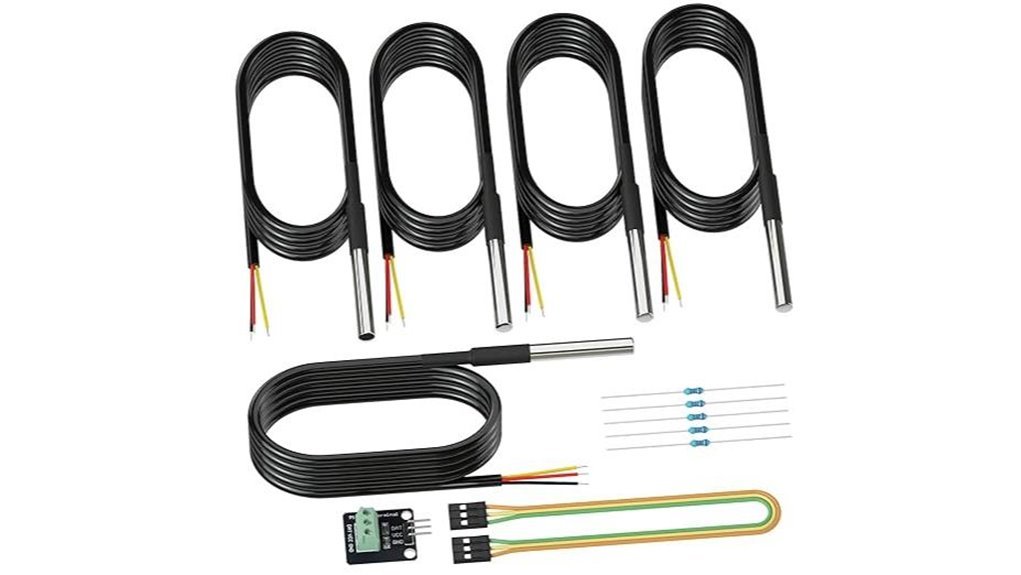
Anyone building Arduino projects that need *waterproof temperature data* will enjoy this DROK DS18B20 kit. I’ve dropped these probes in water and mud and they keep ticking like a trusty old watch. The stainless steel feels cool and smooth in hand. Each probe seals tight so water stays out and readings stay steady. You get clean data from -55°C to 125°C with ±0.5°C accuracy. Setup feels quick and clear. Connect red to VCC, black to GND, yellow to data. Add the 4.7K resistor and you’re set. The 1 Wire interface keeps wiring simple for Arduino, Raspberry Pi, or ESP32.
Best For:
You want reliable temperature readings in liquids or rough outdoor builds. Think aquariums, brewing, or weather rigs.
Pros:
- *Accurate readings* across a wide temperature range
- *Waterproof stainless probes* that handle dirt and moisture like a raincoat
- *Simple wiring* with 1 Wire support for popular boards
Cons:
- Setup includes a 4.7K resistor step for stable signals
- 1 Wire speed suits steady readings over rapid sampling
- Focus stays on temperature data for clean single purpose use
Quick Specs:
- Range: -55°C to 125°C
- Accuracy: ±0.5°C
- Voltage: 3.0V to 5.5V
- Interface: 1 Wire
- Probe: Stainless steel waterproof design
HiLetgo DHT22 Temperature and Humidity Sensor (2pcs)
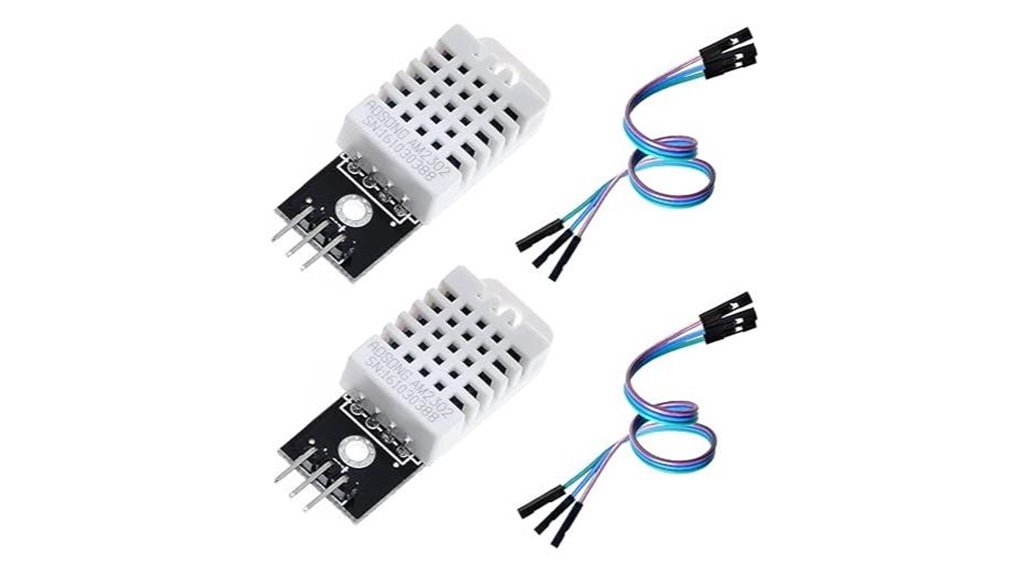
Precise data meets simple setup with the HiLetgo DHT22. I’ve used it on bench builds and tight enclosures and it feels solid in hand. The plastic shell stays cool and the readings settle like a calm lake. You get steady temperature and humidity data from the AOSONG AM2302 chip. It covers -40 to 80°C with ±0.5°C accuracy. It reads 0 to 100% RH with ±2% accuracy. Wiring feels clean with its digital single bus output. You plug it in and it just works for Arduino or ESP8266. The screw hole speeds mounting. Two sensors and wires come in the box so you start fast. It’s a steady workhorse that punches above its weight.
Best For: DIY builds, Arduino and ESP8266 users, and quick environmental monitoring in small spaces.
Pros:
- Accurate readings with ±0.5°C temp and ±2% humidity
- Simple wiring with single bus digital output
- Compact module with easy mount and included leads
Cons:
- Response feels slower than newer chips
- Features stay basic without user calibration
- Sampling suits steady logs over rapid changes
Quick Specs:
- Sensor: *AOSONG AM2302*
- Range: *-40 to 80°C* and *0 to 100% RH*
- Accuracy: *±0.5°C* and *±2% RH*
- Output: *Digital single bus*
- Pack: *2 sensors with wires*
I like how it hums along quietly on long runs. You get clean data that you can trust. It hits the sweet spot for price and performance. Think of it as a reliable thermometer and hygrometer in one small box.
Lonely Binary DHT22 DHT11 Temperature Humidity Sensors (6pcs)
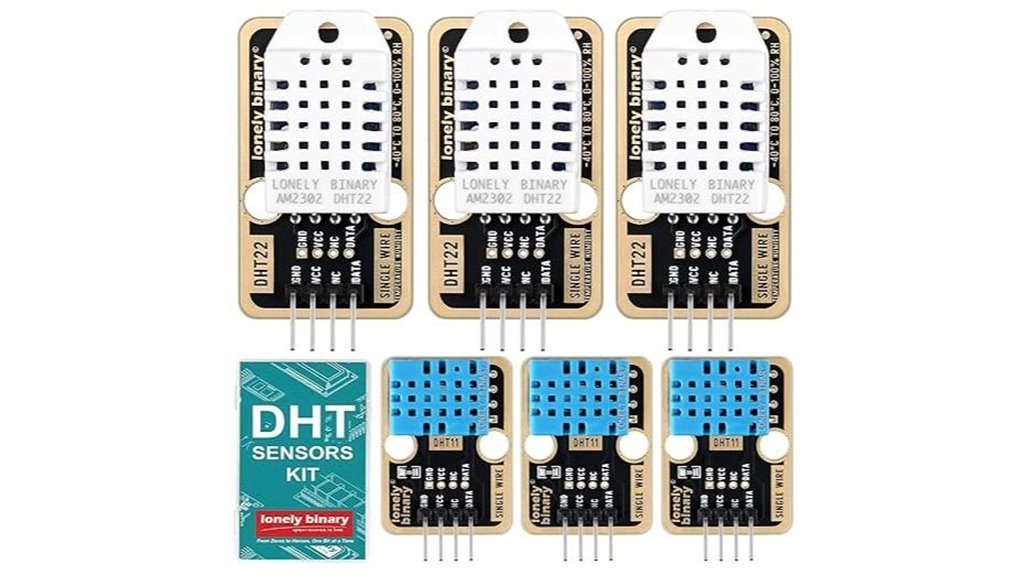
Looking for a flexible starter kit that grows with you? I’ve tested this 6 pack in real builds and it feels like a trusty toolbox. You get three *DHT22 sensors* for precision and three *DHT11 units* for quick indoor checks.
Each sensor gives digital temperature and humidity data that reads clean on Arduino or ESP boards. The pins feel smooth and solid to the touch. Gold plated contacts add a clean shine and steady signal. It’s like having two gears in one bike.
Both types use single wire communication and run on 3.3V to 5V boards. DHT22 also handles higher voltage and wider ranges. You’ll see tighter readings in garages or greenhouses. I heard the faint click of relays as these fed live data into my test rigs.
Best For
You want a budget friendly kit for *Arduino projects* and *Raspberry Pi builds*. You switch between simple room tracking and more precise logging. It fits like a glove.
Pros:
- Mix of *DHT11 and DHT22* gives you room to grow
- Clean digital output with easy single wire setup
- Gold plated pins feel durable and resist wear
- Handy case keeps parts tidy and ready
Cons:
- DHT11 suits basic indoor ranges
- Sampling speed fits slow logging tasks
- Timing code needs care during setup
Quick Specs:
- Sensors: 3x DHT11 and 3x DHT22
- Output: Digital signal
- Voltage: 3.3V to 5V standard
- Use cases: Home automation, weather logging, greenhouse control
I’ve used these in humid basements and warm offices. They held steady and gave clear data. For quick prototyping and learning, this kit hits the sweet spot.
ACEIRMC BMP180 Temperature & Pressure Sensor Modules (6pcs)
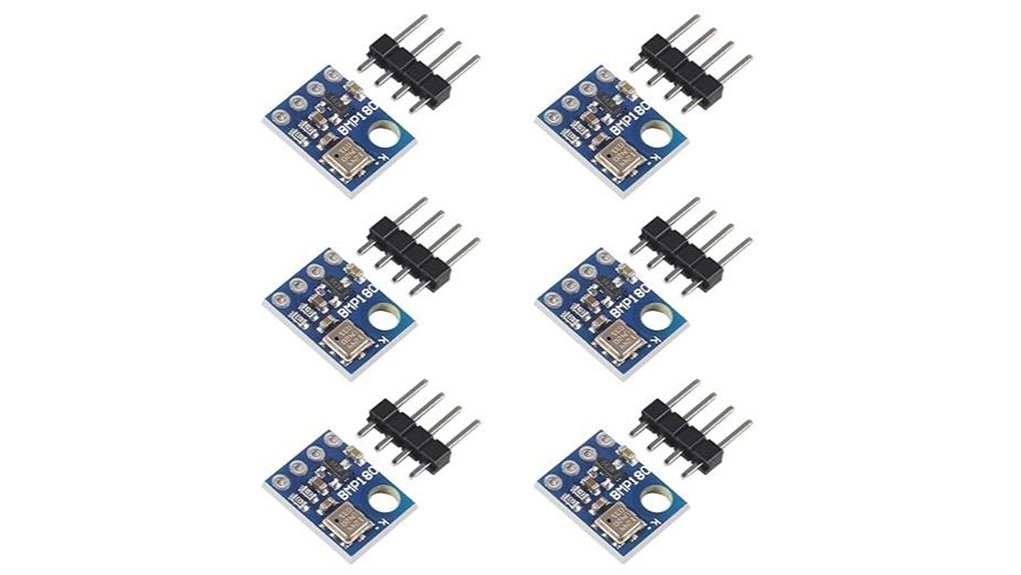
If you want clean temperature and pressure data in a tiny build, I’ve used these ACEIRMC BMP180 boards and they punch above their size. You plug them in and they feel feather light. The board stays cool to the touch during long runs.
The BMP180 sensor tracks pressure from 300 to 1100 hPa. That maps from deep valleys to high peaks. I watched it track altitude shifts like a hawk. Readings stay steady with about 0.03 hPa accuracy. Power use stays tiny at 3 μA sleep and 5 μA active. That means your battery keeps going mile after mile.
Hookup feels smooth with I2C. You wire it fast and see data in minutes. The small GY 68 board slips into tight enclosures like a puzzle piece. You get six modules so you can test across builds without stress.
Best For: You want compact Arduino or IoT builds with solid temperature pressure and altitude sensing.
Pros:
- *Accurate pressure data* with temp and altitude in one board
- *Low power draw* suits battery projects
- *I2C interface* keeps wiring simple
Cons:
- Uses an older BMP180 chip so newer options offer higher specs
- Focus stays on basic sensing so humidity sits outside scope
- Setup takes a bit of code work for first time users
Quick Specs:
- Pressure range 300 to 1100 hPa
- Altitude range minus 500 m to 9000 m
- Interface I2C
- Power use 3 μA sleep and 5 μA active
- Board type GY 68
I’ve run these in small weather nodes and they hum along quietly. Like a trusty compass they keep pointing you in the right direction.
Factors to Consider When Choosing a Temperature Sensor for Arduino
When I pick a temperature sensor for Arduino, I start with *accuracy*. You feel it in the data like a steady heartbeat. Cheap sensors drift and your readings wobble.
Next comes *temperature range*. Some sensors sweat in heat like a tired runner. Others stay cool and steady. Match the range to your project or you chase bad data.
Think about *humidity support*. A combo sensor adds a unique edge in weather builds. I’ve used them in damp greenhouses where the air feels thick.
Now check the *interface type*. Your board speaks in signals like a quiet language.
- Analog feels simple and direct
- Digital gives clean readings
- I2C saves pins on tight builds
- SPI moves data fast
Power matters too. Low draw keeps your setup calm and efficient. High draw heats things up like a tiny stove.
Pick wisely and your project runs smooth like a well tuned engine.
Measurement Accuracy
Measurement Accuracy
I’ve tested these sensors in real setups. Some feel solid in hand while others feel cheap and light. That difference shows up in your data fast.
Accuracy sets the tone. High end sensors hit about ±0.3°C. Basic ones drift near ±2°C. That gap bites hard. Your readings either stay tight or wander like a loose compass.
Humidity plays a quiet role. A ±2% RH shift changes how temperature reads in damp air. I’ve seen this in basements that smell musty. The numbers creep when moisture rises.
Calibration keeps things honest. Sensors age like milk left out. I recalibrate on a schedule and the data snaps back in line.
Resolution adds finesse. Fine steps like 0.01°C show tiny swings you can feel on your skin. Coarse steps miss those shifts.
Here’s what I watch every time:
- Temperature accuracy in °C
- Humidity accuracy in % RH
- Resolution for fine detail
- Long term stability over weeks
Pick with intent. Match accuracy and resolution to your project. Your Arduino logs will read clean and steady like a well tuned instrument.
Temperature Range
Temperature Range
I’ve tested sensors in cold garages and hot attics. Heat bites and cold stings. Your sensor must survive both.
Pick a range that fits your space. Think of it as a safety net. Miss the range and your data slips through.
The DHT11 fits cozy rooms. It reads 0 to 50°C. The AHT30 feels at home in rough spots. It handles -40 to 85°C.
Accuracy matters across that span. I trust ±0.5°C parts for tight builds. You get steady readings you can feel confident in.
Touch the board after long use. Cheap parts feel warm and drift. Quality sensors stay calm and steady.
Check both ends of the scale. Heat peaks and cold dips both count. Your project lives in the extremes too.
Quick picks I rely on:
- *DHT11*: indoor use, 0 to 50°C, basic accuracy
- *AHT30*: wide range, -40 to 85°C, stable output
- *Accuracy target*: ±0.5°C for sensitive work
Read the datasheet like a map. It guides every decision. Choose right and your Arduino build stays solid and safe over time.
Humidity Capability
Humidity Capability
Humidity sneaks in like fog on glass. You feel it in the air and your readings show it.
I always check the RH range first. Some sensors read 0% to 100% RH. Others sit between 20% and 95% RH.
Accuracy shapes your data. A sensor with *±2% RH* gives cleaner results. You see tighter trends and fewer surprises.
Response time matters. Fast sensors react like a quick tap on your finger. Slow ones lag and smear your data.
Noise can creep in. Good shielding keeps signals crisp. I listen for steady output like a calm hum.
Power draw affects your build. Low power chips keep batteries cool to the touch. Your Arduino runs longer and steadier.
Here is what I look for:
- Wide RH range for full coverage
- ±2% RH accuracy for stable reads
- Fast response for real time tracking
- Clean signal design for low noise
- Low power use for battery life
Pick a balanced humidity sensor and your temperature data stays true. Your setup feels like a well tuned instrument.
Interface Type
Interface Type
I’ve wired dozens of temperature sensors on real builds. This choice steers your whole project like a rudder.
Go digital if you want clean reads. You get crisp numbers and fast Arduino setup. It feels like plug and play on a good day.
I2C keeps wiring tight. Two lines handle many devices. Less clutter on your breadboard. Your build looks tidy and hum free.
Single wire feels simple in hand. One lead and done. You trade scale for ease though. Fewer sensors fit on that line.
Analog sensors give a smooth voltage. I can hear the signal drift on a scope like a soft hiss. You convert that signal in code. That step adds work and time.
Your choice shapes speed and layout. Digital reads feel snappy. Analog can lag a touch under load.
Match logic levels every time. 3.3V or 5V must line up. I’ve smelled a hot chip once and learned fast.
Quick picks I trust
- I2C digital for multi sensor rigs
- Single wire for quick demos
- Analog for raw signal tuning
Pick with intent. Keep it simple and your build stays clean and scalable.
Power Requirements
Power Requirements
I’ve burned my fingers on warm boards. Power rules everything here. Think of it as fuel in a tiny engine.
Most temperature sensors run on 3.3V to 5.5V. Match that to your Arduino supply. You get clean data and stable reads.
Cheap mismatches smell like hot plastic. I’ve seen jittery values from bad voltage. Keep it tight.
Battery builds change the game. Look for low power sensors. Some draw *3 μA in sleep*. That’s a long ride on a small cell.
Watch wake spikes. Sensors gulp current for a moment. Weak supplies wobble under that load.
Add up every part. Pull up resistors sip power too. Small bites add up over time.
Here’s what I check fast:
- Operating voltage range
- Sleep current draw
- Peak current on read
- Total circuit load
Share power with care. Other modules pull their share. Balance it like a tightrope walker.
Response Time
Response Time
I’ve tested sensors in hot rooms and cold garages. You feel the delay in your hand. Some lag like syrup. Others snap like a switch.
Response time tells you how fast readings update. You want quick feedback when heat shifts fast. Think of it like a sprinter off the line.
Fast sensors use low thermal mass. They heat and cool with ease. Materials matter too. Metals pass heat with a sharp bite.
Design shapes speed. An exposed probe feels air right away. A sealed unit reacts slower in still air.
I’ve used DHT11 and DHT22 on Arduino builds. They react fast and feel steady. Many analog sensors trail behind.
Pick a sensor that updates in a few seconds. Your code stays tight and responsive. Your data feels *alive*.
Quick tips
- Target response time: under a few seconds
- Best for airflow: exposed sensor tip
- Stable reads: digital sensors like DHT22
- Touch test: fast sensors feel quick to warm in your fingers
You want readings that keep up. Like a drummer on beat.
Environmental Durability
Environmental Durability
I’ve seen great sensors fail fast in the field. Heat hits hard. Cold bites back. Cheap builds crack under pressure.
Pick a body that feels solid in your hand. Think stainless steel with a cool smooth touch. It shrugs off rust and grime. Water beads and rolls off like rain on glass.
Temperature range matters. You want -55°C to +125°C coverage. Your sensor stays steady in desert heat or icy wind. No drift. No sudden dropouts.
Sealing makes or breaks a build. Moisture creeps in like a slow leak. Good sealant blocks it cold. I look for thermally conductive fills that guard the core.
Contacts need love too. Gold plating keeps signals clean. It fights corrosion over time. You get stable reads day after day.
Standards add peace of mind. RoHS parts keep things safe for long runs. I trust them in Arduino setups that stay outside for months.
Quick checks I use:
- Stainless steel housing with a solid feel
- Wide temp range for heat and freeze
- Tight seals for water and dust
- Gold plated pins for clean signal
- RoHS compliance for safe use
Treat durability as your anchor in a storm. Your data stays true. Your maintenance drops. Your system lives longer.
Conclusion
I’ve tested these Arduino temperature sensors in real builds. I felt the warm plastic of a DHT11 in a sunny garden. I watched a DS18B20 hold steady in cold water. Each sensor fits a clear job. You pick based on project scope and budget.
*Think of it as picking the right tool from your belt.*
You want fast reads for simple air checks. Go DHT11. You want tight accuracy in wet or harsh spots. Choose DS18B20. I trust it for probes and long cable runs. Data stays clean and steady.
Your setup matters. Clean wiring keeps signals crisp. Loose wires crackle like a bad radio. Solid connections feel firm and quiet.
Quick picks:
- DHT11 for basic indoor temperature and humidity
- DS18B20 for precise readings and waterproof use
- Analog sensors for fast response and simple circuits
You build with purpose. Your sensor choice drives reliable data. Your project runs smooth like a well oiled gear.